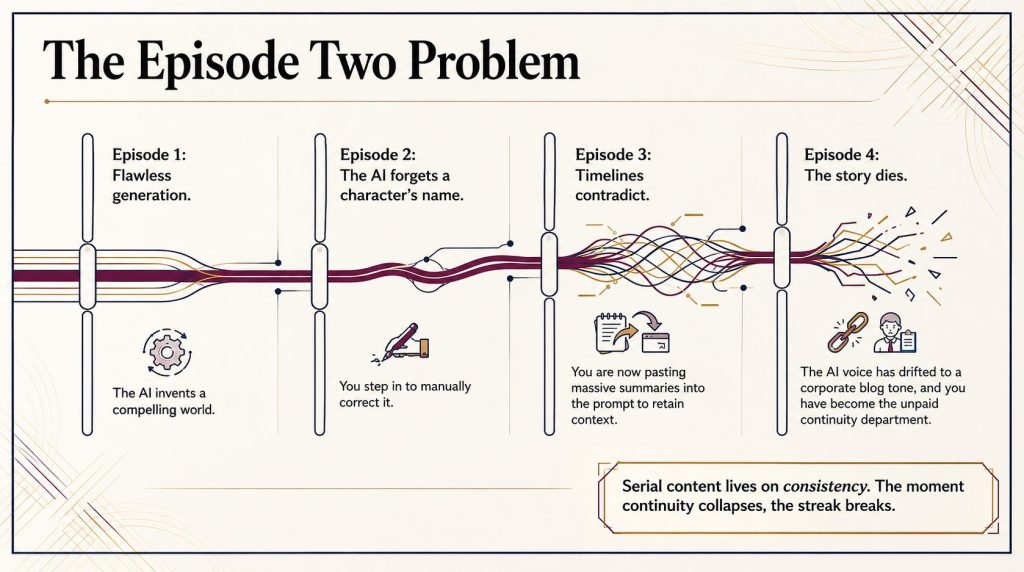
By the tenth episode, many AI writing tools force you to manually re-enter character notes and story details just to stop the AI from forgetting its own narrative. This Saga Post The Never Ending Story Machine Review found that Saga Post marketed on WarriorPlus as “The Never-Ending Story Machine”—was built specifically to solve that problem. Its standout feature is a persistent memory layer that allows the AI to remember characters, locations, relationships, and important plot points, helping ensure that someone introduced in chapter one remains consistent even forty chapters later instead of being randomly rewritten or forgotten.
Quick Verdict
StoryCraft Kids AI Bedtime Story System is a one-time $17 purchase created for parents, grandparents, teachers, and caregivers who want to generate personalized bedtime stories using free AI tools like ChatGPT, Claude, or Gemini. In this StoryCraft Kids AI Bedtime Story System Review, we found the front-end package includes 346 professionally written prompts, 10 storytelling engines, a browser-based Prompt Picker, ready-to-use sample stories, and illustrated covers without requiring a paid AI subscription.
👉 Check StoryCraft Kids Launch PriceBefore drafting this Saga Post review, we carefully reviewed the live WarriorPlus affiliate dashboard, the vendor’s track record, and the most comprehensive independent analysis we could locate including a pricing change that occurred midway through the launch, which you should be aware of before making a purchase.
Table of Contents
What Saga Post Actually Does
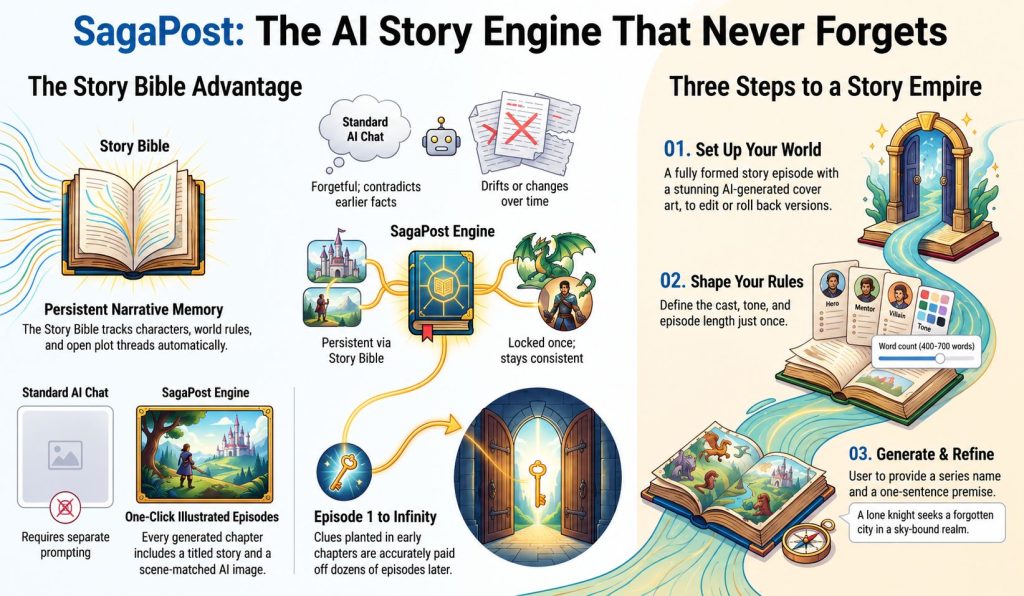
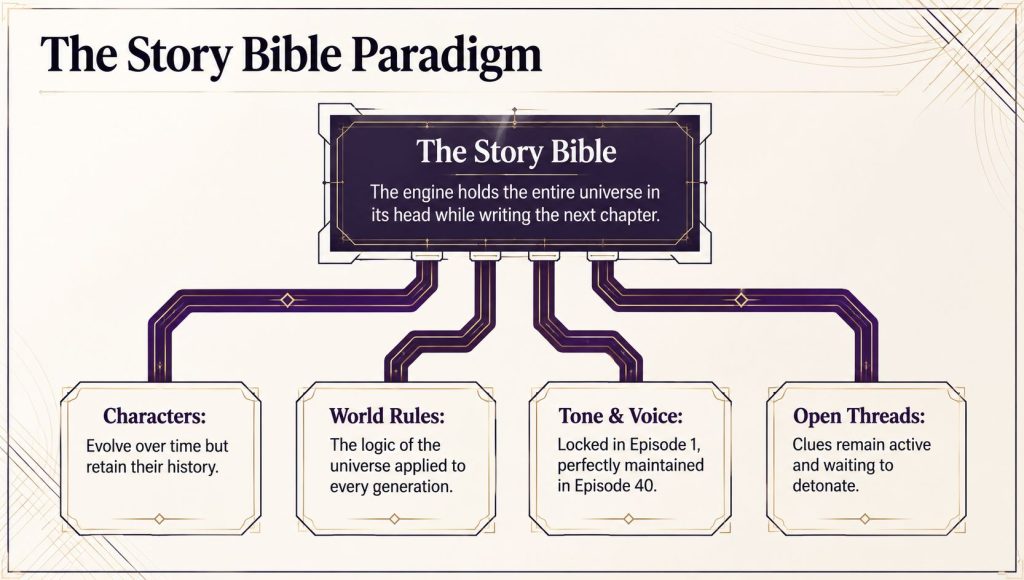
The Saga Post The Never Ending Story Machine Review reveals that Saga Post is built around a core feature the vendor calls the “Story Bible”—a persistent memory system attached to every story series you create. Instead of starting each AI-generated episode from a blank slate, you set up your series once by defining its title, genre, one-sentence premise, main characters, and overall tone.
That information then becomes a permanent set of rules the AI follows for every future episode, helping maintain consistent characters, plot points, relationships, and world-building. This Saga Post The Never Ending Story Machine Review found that the Story Bible is the platform’s standout feature because it addresses one of the biggest weaknesses of traditional AI writing tools: maintaining long-term continuity across an ongoing series.
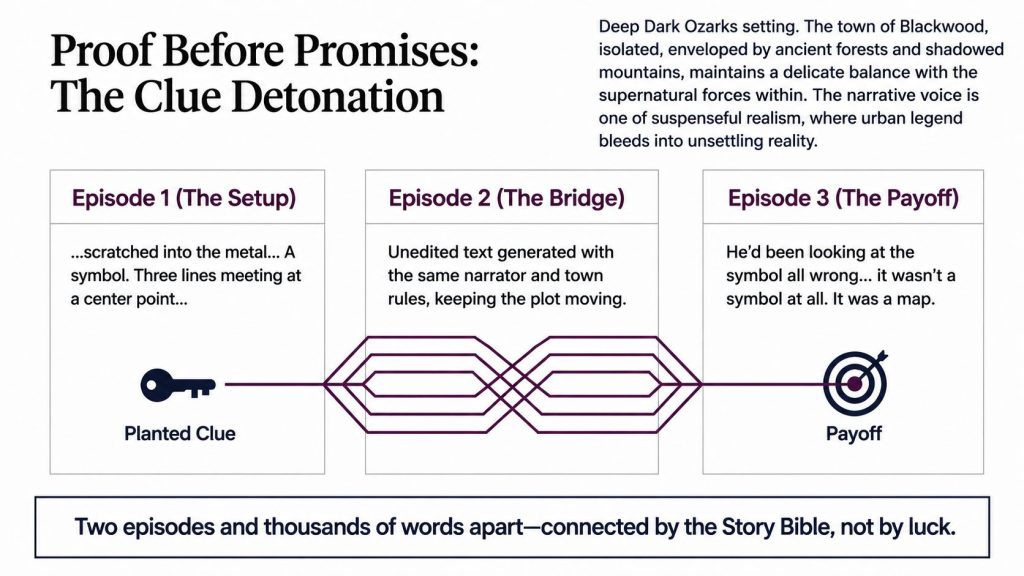
In practice, this means that a minor element introduced in episode one such as a character’s trait, a secret backstory, a setting, or a key item can naturally recur in episode thirty or later without requiring you to repeatedly copy the same notes. In this Saga Post The Never Ending Story Machine Review, we discovered that its persistent memory feature sets it apart from standard AI writing tools, which merely produce disconnected content fragments.
Every episode produced within Saga Post comes with fully written story text paired with a corresponding AI-generated scene image, offering a more comprehensive publishing package rather than merely text. You have the option to review the episode, manually edit it, regenerate just the section that needs tweaking, or revert to a previous version via the built-in version history. This workflow empowers writers with greater control, as experimentation doesn’t result in the loss of prior work.
However, this Saga Post The Never Ending Story Machine Review also makes one thing clear: this is not a magic button that creates a complete franchise without any creative input. You still have to supply the initial concept, characters, and overall direction. The AI performs most effectively when you supply it with a solid foundation, since the Story Bible can only retain and build upon the information you give it. For creators with story ideas but difficulty maintaining long-form projects, Saga Post functions more as a creative partner and continuity manager than as a substitute for human imagination.
Creator Trust Assessment: Who Is Jeremy Kennedy?
This part of our Saga Post The Never Ending Story Machine Review is more important than many buyers recognize, so it’s worth reviewing the vendor’s background rather than depending solely on the sales page. The public WarriorPlus profile indicates over 41,000 lifetime sales across 18 products and nearly 12,000 followers, reflecting a long-standing presence in internet marketingspanning more than a decadeunder the same name and brand. That history includes jeremykennedy.net, an active WarriorChat community, and several prior launches recorded on independent launch-calendar sites.
In our research for this Saga Post The Never Ending Story Machine Review, this scenario stands out as notably different from purchasing software from a brand-new WarriorPlus account that lacks an established reputation. A vendor with years of built credibility stands to lose significantly if a product underperforms, as repeat customers, affiliates, and public reviews directly influence future product launches. Although a strong history doesn’t ensure every new product will be exceptional, it adds a level of accountability that most debut products lack. That’s a key factor to keep in mind if you ’re considering investing in a tool you’ll depend on for ongoing content creation.
To maintain balance, we should also note that one generic automated website safety scanner gave the vendor’s personal website a relatively low algorithmic trust score. We wouldn’t treat that as conclusive evidence because automated scanners frequently flag small, independently operated marketing websites using broad rules that also affect many legitimate businesses. Rather than ignoring that data point, we’ve included it here so this Saga Post The Never Ending Story Machine Review reflects both the positive findings and the cautionary observations, giving readers a more transparent and balanced view before making a purchase decision.
The Funnel, Fully Mapped (And a Price Change Worth Knowing)
Here’s the honest, current state of the funnel as of this week — with a flag on something that changed since launch day:
| Step | Product | Price | What It’s For |
|---|---|---|---|
| FE (pick one) | Starter | $9.95/month | 31 episodes/month, all genres, Story Bible engine |
| FE (pick one) | Creator | $27/month | 100 episodes/month, multiple story universes |
| FE (pick one) | Pro | $47/month | 300 episodes/month, priority generation |
| FE (pick one) | Agency | $27 one-time* | Unlimited episodes, bring your own OpenAI/Claude API key, no subscription |
| Order Bump | DFY Story Vault | $9.95 | 500+ ready-made story franchises (concept, world, cast, tone guide, launch prompt) |
| OTO1 | StoryCrafter AI | $19 | Builds full story universes/franchise concepts to feed into Saga Post |
| OTO2 | StoryTeller Pro | $27 one-time* | Converts episodes into AI voice narration (bring your own ElevenLabs key) |
| OTO3 | Commission Coalition | $97 | Private mastermind community, discounted from a stated $497 regular price |
*Flagged: independent coverage published on launch day priced the Agency plan and the StoryTeller Pro upgrade at $19 each. As of this week, both now show $27 on the live affiliate dashboard — an $8 increase on each, which lines up with a standard WarriorPlus price-increase-as-it-sells structure rather than any kind of bait-and-switch. Still, it means the number you see in a review (including this one) may not be the number you see at checkout by the time you click through — always confirm current pricing on the actual order page.
Buyers pick exactly one front-end plan (not all four), then see the order bump and the three OTOs. There’s no unrelated or unlisted product hiding anywhere in this funnel — all 11 dashboard line items map cleanly onto what’s described above.
Subscription vs. One-Time: How the Billing Actually Works
One of the key insights from our Saga Post The Never Ending Story Machine Review was the pricing structure, which can be misleading at first glance. Three of the four front-end plans Starter, Creator, and Pro are monthly subscriptions, so you ’ll keep paying each billing cycle as long as your account stays active. Each plan comes with a monthly episode allowance31, 100, or 300 episodes, depending on your tierand these limits reset when your subscription renews. Ceasing payment also means you lose access to the managed service that enables the AI generations.
The fourth option, Agency, operates in a completely different way. Rather than offering a recurring monthly charge, it is available as a one-time purchase. This is possible because Saga Post no longer bears the cost of AI processing for you. Instead of relying on the vendor’s managed AI infrastructure, you can connect your own OpenAI or Claude API key, allowing you to pay the AI provider directly for the content you create. This method offers more flexibility to experienced users and removes recurring subscription charges, though it demands slightly more technical setup than managed plans.
Before selecting a plan, consider realistically estimating how many episodes you’ll produce each month, rather than just choosing the cheapest option or the one marked “ Most Popular.” A person publishing just a few stories each month might find the Starter plan more than enough, whereas a creator juggling multiple ongoing series could hit the Creatoror even Prolimits fairly quickly.
In that scenario, the Agency plan could offer greater long-term value, as its upfront cost may outweigh months or years of subscription feesparticularly when combined with the low, pay-as -you -go pricing typical of modern AI APIs. As emphasized throughout this Saga Post The Never Ending Story Machine Review, choosing the right plan hinges more on your publishing volume than on the initial purchase price alone.
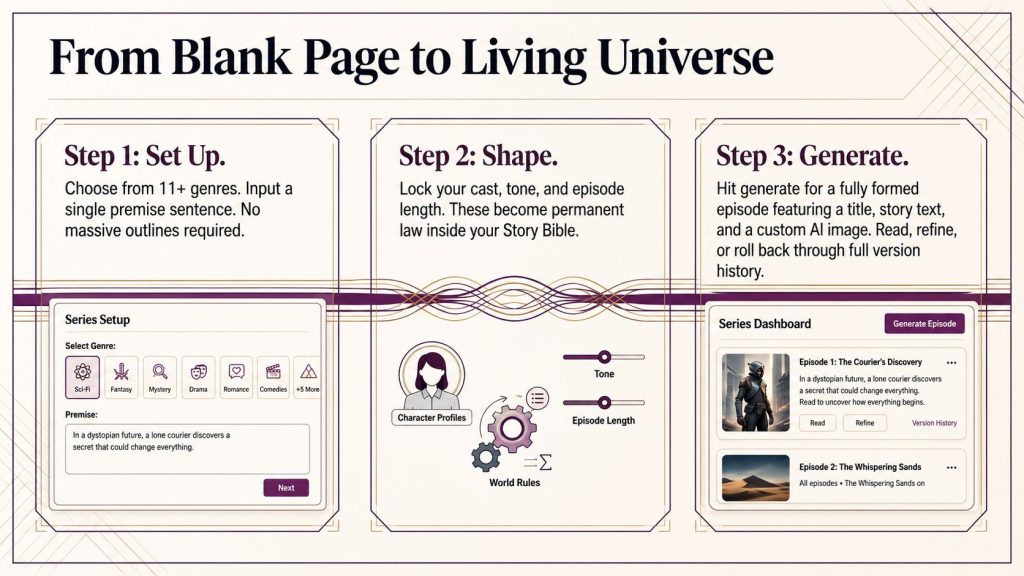
Using Saga Post Step by Step
Set Up Your World (2–5 Minutes)
A short wizard asks for a series name, genre, and a one-sentence premise. A single sentence is genuinely enough to start — you don’t need a full outline.
Lock Your Cast And Tone Once (5–10 Minutes)
Characters, voice, and target length get defined here. These choices become the standing rules the Story Bible applies to every future episode automatically.
Generate An Episode (1–2 Minutes)
Each generation returns a title, episode text, and a matching AI image. Read before publishing, just like any AI output.
Refine As Needed (Variable)
Regenerate a single beat, hand-edit anything, or roll back to a previous version — full version history lets you experiment freely.
Repeat On Your Publishing Schedule
The “never-ending” claim is tested here — continuity has to hold at episode 20, not just episode 2.
Cost-Per-Episode: Running the Numbers
A closer look at this Saga Post The Never Ending Story Machine Review reveals that pricing becomes more cost-effective as you upgrade to higher subscription tiers. The Starter plan is $9.95 per month and includes 31 episodes, averaging about $0.32 per episode. The Creator plan increases the monthly allowance to 100 episodes for $27, reducing the cost to roughly $0.27 per episode.
The Pro plan delivers the best value among the managed subscriptions, offering 300 episodes for $47 per month, or approximately $0.16 per episode. This Saga Post The Never Ending Story Machine Review found that the pricing follows the standard software subscription model, where users generating more episodes enjoy a lower cost per episode, making the higher tiers increasingly attractive for frequent publishers.
The Refund Question (What We Could — and Couldn’t — Confirm)
One point we want to be fully transparent about in this Saga Post The Never Ending Story Machine Review is our refund policy. Even after reviewing several sources, we were unable to independently confirm Saga Post’s current refund or money-back guarantee terms. The official sales page is a JavaScript-based application, making much of its content unavailable via standard research tools. Additionally, the most detailed independent review we cited for pricing and product details did not mention a confirmed refund window. The only point consistently highlighted was that there is no free trial, meaning customers are expected to buy before trying the platform.
Who Saga Post Is NOT For
- Anyone who wants an AI tool to invent the entire premise and cast with zero input — you still need to bring a real starting idea.
- Writers who want franchise/world-building bundled into the base tool rather than as a separate upgrade (that’s what StoryCrafter AI, OTO1, is for).
- Anyone who wants narrated audio out of the box — that requires the StoryTeller Pro OTO plus your own ElevenLabs API key, not a built-in feature.
- Buyers who want to try before they pay — there’s no stated free trial.
- Anyone uncomfortable with recurring monthly billing, unless they’re specifically choosing the one-time Agency tier and are comfortable setting up their own API key.
Pros and Cons
✅ Pros
- The core continuity mechanism (Story Bible) solves a real, specific failure point in AI-assisted fiction instead of being a generic “AI writes stories” feature.
- Vendor has a long, verifiable WarriorPlus track record — adding an accountability layer most new launches don’t have.
- Four pricing tiers fit different usage levels, including a no-recurring-fee option (Agency) for heavier users.
- Every episode arrives with a matching image, removing the need for a separate illustration workflow.
- Full version history makes experimenting with regenerations safer.
- Works across 11+ genres and multiple publishing formats including newsletters, podcasts, KDP, and social content.
❌ Cons
- Two funnel prices increased by $8 within the first three days of launch — confirm current pricing before purchasing.
- No independently confirmed refund or guarantee terms were found.
- No free trial is available to test the continuity claim before paying.
- Three of four plans are recurring subscriptions with monthly episode caps, not simple one-time purchases.
- Audio narration requires a separate paid upgrade plus your own third-party API key.
- You still need a real premise and cast idea — it does not completely replace the creative starting point.
Pre-Subscribe Checklist
- Decide which front-end tier actually matches your publishing volume — don’t default to the “most popular” label without checking your real episode count needs.
- Confirm the live price at checkout, since two funnel items rose $8 within days of launch.
- Read the current refund/guarantee terms on the actual checkout page before paying — this review could not independently confirm them.
- If considering Agency, make sure you’re comfortable creating and billing your own OpenAI or Claude API key.
- Decide upfront whether you need the DFY Story Vault order bump for skip-the-blank-page help or already have your own premise ready.
- Only add StoryCrafter AI (OTO1) if you specifically want help building franchise/world concepts, not just individual episodes.
| Category | Blank AI Chat | Saga Post |
|---|---|---|
| Continuity across episodes | You manually re-explain everything each time | Story Bible applies it automatically |
| Voice consistency | Drifts over time | Locked once, reused every episode |
| Illustrations | Separate tool, separate prompt | Generated automatically with each episode |
| Version control | None | Full history with rollback |
| Cost at low volume | Free (with your existing AI subscription) | $9.95–$47/month, or $27 one-time plus your own API cost |
| Best for | One-off pieces, no ongoing series | Any series meant to run past a handful of episodes |
The honest trade-off: if you’re only ever writing a single short story, a free AI chat costs nothing and does the job. Saga Post earns its price the moment you’re trying to keep a series consistent past episode five or six, which is exactly the point where manual prompting starts to break down.
Frequently Asked Questions – Saga Post The Never Ending Story Machine Review
Get These 6 Bonuses When You Buy Through My Link
I’ve added these extra bonuses to help you get more value from your purchase and move faster with promotion, automation, traffic, and sales.
DFY Social
A done-for-you social media bonus created to help you promote offers faster without starting from a blank page.
Quantum AI
A powerful AI-focused bonus designed to help you improve productivity, create faster, and simplify your online workflow.

Anonymous AI
Learn how to build and promote online using AI without needing to show your face or become a personal brand.

Video Marketing Profits
A practical bonus focused on using simple videos to attract attention, build trust, and drive more clicks to your offers.

High Ticket AI
This bonus helps you understand how AI can be used around premium offers, positioning, and higher commission opportunities.
Traffic Funnel Blueprint
A simple funnel blueprint to help you understand how to move visitors from traffic sources toward your affiliate offer.