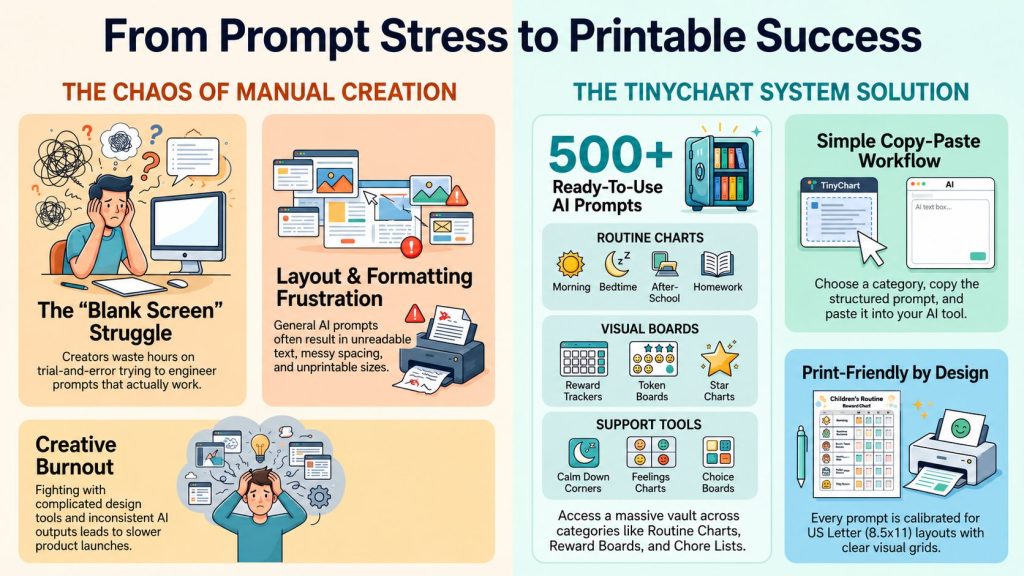
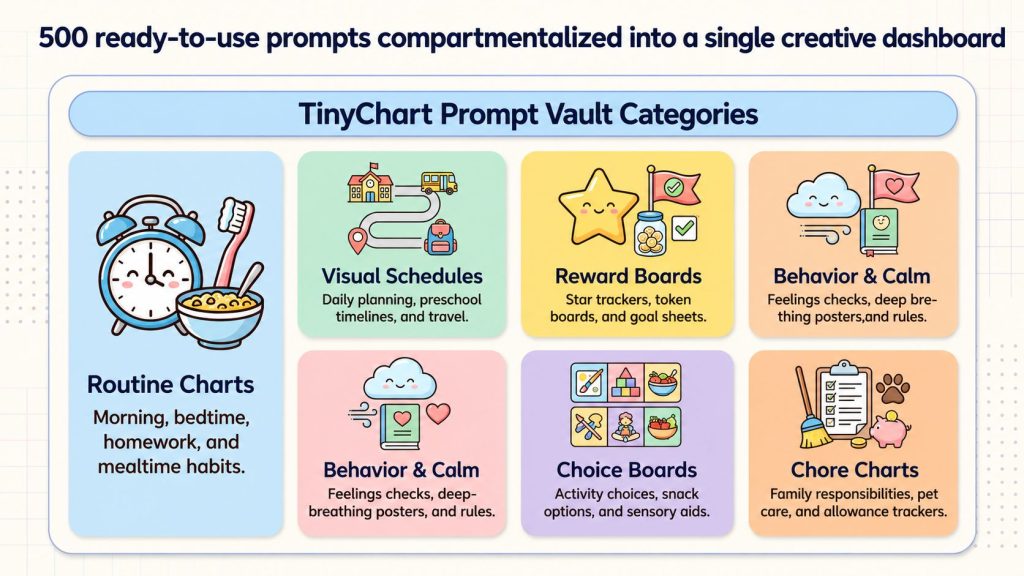
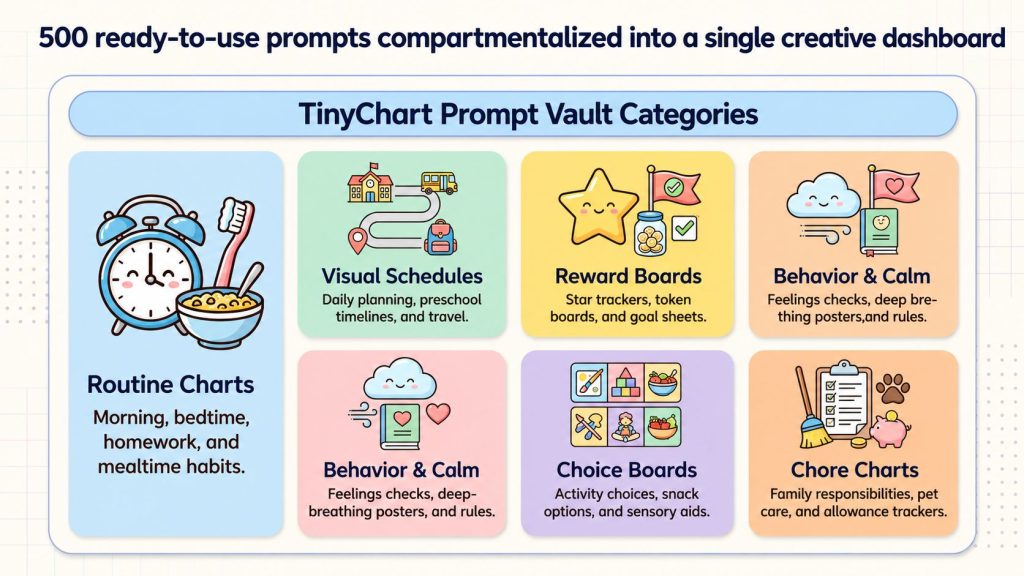
If you’re searching for an honest TinyChart Prompt Vault Review, you’ve come to the right place. TinyChart Prompt Vault is designed to help creators produce high-quality kids’ printable charts without spending hours writing AI prompts from scratch. Rather than being another AI design tool, it offers a curated collection of more than 500 ready-to-use prompts for creating routine charts, reward boards, visual schedules, chore charts, behavior trackers, and other child-friendly printables using AI tools like ChatGPT.
With a one-time price, commercial use rights, and prompts organized into easy-to-browse categories, it’s aimed at KDP publishers, Etsy sellers, teachers, homeschool parents, and digital product creators who want to streamline their workflow. In this TinyChart Prompt Vault Review, we’ll explore what’s included, who it’s best suited for, its key advantages and drawbacks, pricing, licensing, and whether it’s worth adding to your digital publishing toolkit.
TinyChart Prompt Vault Review —
500+ AI Prompts for Kids Printables, Tested for Real
A $17, single-purchase prompt vault for creating cute kids routine charts, reward boards, and visual schedules with ChatGPT or another AI image tool. Here’s exactly what’s inside, what it costs, and what we could and couldn’t verify.
⚠ Editorial First-Look Assessment — Not a Verified-Buyer Star Rating
Table of Contents
Quick Verdict
TinyChart Prompt Vault is a refreshingly simple funnel — one $17 front-end purchase, no OTO staircase, and a clearly stated 30-day guarantee. The 500+ prompts cover a genuinely in-demand niche (kids routine charts, reward boards, and classroom visuals sell well on Etsy and KDP), and the sales page itself was fully readable, which let us confirm the price, bonuses, and refund language directly rather than guessing. What we couldn’t confirm: the exact WarriorPlus commission percentage, and any independently documented track record for the two named creators. Read on for the full breakdown before you buy.
Quick Summary: What Is TinyChart Prompt Vault?
TinyChart Prompt Vault is a $17, one-time-purchase collection of over 500 done-for-you AI prompts built specifically for creating cute, print-friendly kids charts and visual boards. Rather than a video pack, software, or a full AI generator, it’s a structured prompt library — you copy a prompt, paste it into ChatGPT or another AI image tool, and generate a printable design concept for things like morning routine charts, reward boards, visual schedules, calm-down posters, and chore charts.
The vault is organized into categories (routine charts, visual schedules, reward and token boards, behavior and calm-down tools, choice boards, and chore charts) and includes nine cute style directions — kawaii classroom, woodland storybook, outer space, under the sea, dinosaur, unicorn rainbow, cute farm, jungle safari, and fairy garden. This TinyChart Prompt Vault review focused on three things: what’s actually inside the vault per the sales page, whether the funnel hides any upsells, and what could and couldn’t be independently confirmed about the people behind it.
Is Kids Printables Actually a Good Niche Right Now?
Before judging any prompt pack, it’s worth checking whether the underlying niche has real demand. Kids printables—routine charts, reward boards, behavior trackers, and classroom visuals—have been a durable, steadily selling category on Etsy and Amazon KDP for years, driven by parents, homeschoolers, and teachers who want practical, low-cost tools rather than expensive apps or subscriptions. In this TinyChart Prompt Vault Review, we’ll examine whether this prompt collection is well-positioned to help creators tap into that evergreen market and produce print-ready products more efficiently.
Unlike trend-driven niches that spike and fade, this category has consistent, evergreen search demand. Terms like “morning routine chart,” “reward chart printable,” and “visual schedule for kids” are searched year-round rather than only during seasonal peaks. That’s a favorable backdrop for a product like the one featured in this TinyChart Prompt Vault Review, since creators can build themed shops—such as woodland storybook routine charts or space-themed reward board collections—and continue producing fresh variations without quickly exhausting buyer interest.
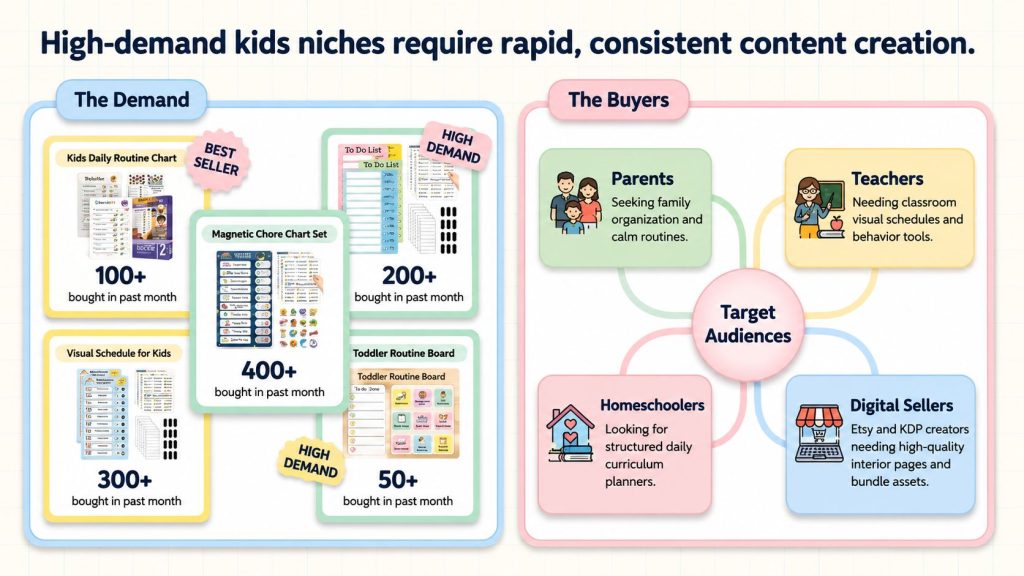
That said, the niche is also genuinely competitive. Etsy’s printables category is crowded, and a generic, unbranded chart alone won’t automatically outperform established shops with hundreds of five-star reviews. As discussed in this TinyChart Prompt Vault Review, what this prompt vault primarily solves is the blank-page problem—helping users decide what to prompt, which layouts to use, and which style directions are more likely to produce clean, printable results. It doesn’t replace the ongoing work of building a successful shop through branding, SEO, customer trust, and repeat buyers. Buyers should approach it as a tool that provides a strong head start, not a complete business solution.
It also helps to look at who’s actually buying in this space. Parents make up the largest share of demand, typically searching for a specific problem — bedtime resistance, morning chaos, chore reminders — rather than browsing generically, which means listings with a clear, specific promise (“bedtime routine chart for toddlers”) tend to outperform vague ones. Teachers and homeschool parents form a second, steady buyer segment, often purchasing in bundles around the start of a school term or semester.
Both groups respond well to a consistent visual style across a themed collection, which is exactly the kind of output a structured prompt set is built to produce more reliably than one-off, individually-written prompts. A third, smaller but often overlooked buyer group is corporate and therapy-practice buyers — occupational therapists, speech therapists, and family counselors frequently purchase visual schedule and calm-down materials in bulk for clinical use, and this segment tends to value clarity and consistency even more than pure visual cuteness, which is worth keeping in mind when choosing which style direction to lean on for that particular audience.
What’s Actually Inside the Vault – TinyChart Prompt Vault Review
| Component | What It Covers | Seller’s Claimed Value |
|---|---|---|
| Main TinyChart Prompt Vault | 500+ ready-to-use AI prompts across all categories | $197 |
| Routine Chart Prompts | Morning, bedtime, after-school, homework, cleaning, mealtime | $97 |
| Visual Schedule Prompts | Classroom, homeschool, therapy, daily planning, travel | $97 |
| Reward Chart Prompts | Star charts, sticker charts, potty training, goal trackers | $97 |
| Token Board Prompts | 3-token, 5-token, themed reinforcement visuals | $67 |
| Behavior Chart Prompts | Good-choice trackers, classroom rules, responsibility tables | $67 |
| Calm Down & Feelings Prompts | Coping-skill sheets, breathing posters, emotion cards | $134 |
| Choice & Chore Board Prompts | Snack/activity choice boards, chore lists, allowance trackers | $134 |
| Commercial Use License | Use for KDP interiors, Etsy printables, lead magnets | $197 |
| 3 Fast-Action Bonuses | Routine Expansion, Classroom/Homeschool, Reward/Behavior packs | $231 |
Adding up the seller’s own per-item figures gets close to their advertised “$1,489 total value” claim, which — as with any sales page value stack — should be read as a marketing anchor rather than an appraised price; nobody would realistically pay $197 for a folder of prompts on its own. The number worth focusing on instead is the $17 front-end price of TinyChart Prompt Vault itself, since that’s the actual cash outlay, and it’s confirmed directly and consistently on the live sales page.
What Kids Printables Actually Sell For (So You Can Judge the Math)
To judge whether $17 for TinyChart Prompt Vault makes financial sense, it helps to know roughly what the finished output tends to sell for once listed. Single printable charts (one routine board, one reward chart) commonly list in the $2–$6 range on Etsy, while themed bundles of 8–15 matching pieces — the kind of output a structured prompt set is built to produce — typically list between $7 and $18.
Classroom and homeschool-specific bundles, aimed at teachers rather than individual parents, often sit at the higher end of that range or get sold as part of a larger resource pack. None of these figures are guarantees of what any individual seller will earn — Etsy pricing depends heavily on shop reputation, SEO, and niche saturation — but they give a rough sense of why even a single themed bundle sale can outweigh the $17 cost of the vault itself.
The Funnel Check: A Clean, Refreshingly Simple Result
✅ Funnel Discrepancy Check — Clean Result, No OTOs Found
Standing practice on this site is to check every funnel for hidden upsells, topic pivots, or price surprises before writing. TinyChart Prompt Vault came back genuinely clean: it’s a single front-end purchase at $17, with three included fast-action bonuses and no separate OTO or downsell pages found anywhere in the checkout path. That’s worth calling out directly, since most WarriorPlus launches run a multi-step upsell sequence — this one doesn’t, at least based on what the live sales page and checkout link show.
Because this is a single-offer product rather than a multi-tier funnel, there’s no tier-comparison math to run here the way there would be on a volume-based PLR pack — the only real pricing decision is whether $17 for this vault is worth it at all, which the pricing section below looks at directly.
What We Could Verify — And What We Couldn’t
⚠ What Couldn’t Be Independently Confirmed
Two specific things couldn’t be confirmed for this TinyChart Prompt Vault review. First, the exact WarriorPlus affiliate commission percentage — the affiliate redirect page renders through JavaScript and returned no readable commission data through automated research, so promoters should check their own WarriorPlus affiliate dashboard directly rather than assume a figure. Second, an independently documented, multi-year public track record for either named creator, Owen Benet or John Duhi — no complaint pattern was found either, but there also isn’t yet the kind of outside coverage or launch history that would let this review vouch for them the way it could for a longer-established vendor.
About the Creators: Owen Benet & John Duhi
The sales page for TinyChart Prompt Vault credits two people: Owen Benet, billed as “Product Lead & Content,” described as focusing on simplifying complex creative workflows for creators, and John Duhi, billed as “Tech Architect & AI,” described as turning complicated prompt configurations into simple, deployable menus. Both are shown with names and photos on the sales page itself, which is a step beyond a fully anonymous listing.
What this review has to be direct about: neither name turned up an independently documented, multi-year public launch history through search — no pattern of prior WarriorPlus products, no outside interviews, no long-running brand presence that could be cross-checked the way a more established vendor’s track record could be. That’s not the same as a red flag; no complaint pattern was found either. But it does mean this is a newer or lower-profile creator team whose reputation is still being built, and buyers should weigh that accordingly, particularly given the limited independent information available on the refund process in practice rather than just in policy wording.
For context, this is a common pattern on WarriorPlus launches in the kids-printables and prompt-pack space specifically — a large share of vendors in this niche are relatively new sellers rather than long-established brand names, since the barrier to producing a prompt-based digital product is low. That doesn’t excuse the lack of a verifiable history, but it does mean holding this prompt pack to a “newer vendor” standard rather than expecting the kind of multi-year documentation you’d reasonably want from a $200+ software purchase is a fair way to calibrate expectations for a $17 prompt pack.
Pricing: Is $17 Actually Worth It?
At $17 for a single front-end purchase, TinyChart Prompt Vault is priced low enough that the math is fairly forgiving. If even one finished printable pack built from these prompts sells for $17 or more on Etsy — and reward charts, routine boards, and classroom visual bundles commonly list in the $4–$15 range individually, with bundled sets often priced higher — a single sale can cover the cost of the entire vault, putting a buyer in profit after that first sale, before counting the other 499-plus prompts still sitting unused in the library. That’s a meaningfully different risk profile than a $47–$97 front end where a buyer needs several sales just to break even.
The honest caveat is that this prompt vault sells prompts, not finished, ready-to-list products — the sales page is explicit that ChatGPT or another AI image tool is required separately, and that results will vary by tool, settings, and how much the buyer edits and refines the output. Buyers who expect to unzip a folder of print-ready PDFs and upload them straight to Etsy will be disappointed; buyers who understand this is a structured starting point for their own AI generation and editing process are more likely to find the $17 reasonable.
It’s also worth comparing this to the alternative of buying a pre-made, ready-to-list printable pack from another PLR marketplace, which often costs anywhere from $20 to $50 for a much smaller set of fixed designs that every other buyer of that same pack also owns — meaning your finished shop can look identical to a competitor’s. A prompt-based approach costs less upfront and produces different output every time depending on your specific inputs and edits, which naturally reduces the “everyone has the same files” problem that fixed PLR graphic packs run into, even though it shifts more of the finishing work onto the buyer.
Prompt Vault vs. Writing Your Own Prompts From Scratch
It’s worth asking directly whether a buyer even needs a product like TinyChart Prompt Vault instead of just typing requests into ChatGPT themselves. In practice, generic prompts for “a cute kids routine chart” tend to produce inconsistent results — text that’s too small to read once printed, spacing that doesn’t leave room for checkboxes, or styling that drifts away from a clean, printable US Letter layout. Getting consistently clean output usually requires specifying page size, layout structure, title placement, readable text sizing, and negative-prompt guidance (telling the AI what to avoid) on every single request, which is exactly the repetitive work TinyChart Prompt Vault is trying to remove.
The tradeoff is that a structured prompt vault only saves meaningful time if the buyer is planning to generate more than a handful of designs — for a single one-off chart, writing a custom prompt from scratch is arguably just as fast. Where this prompt vault earns its price is in volume and consistency: producing a themed 20- or 30-piece printable collection with a repeatable visual identity across all the pieces, rather than one-off results that don’t match each other.
The Nine Style Directions, and Why Picking One Matters
The sales page lists nine cute style directions included across the prompt categories: kawaii classroom, woodland storybook, outer space, under the sea, dinosaur, unicorn rainbow, cute farm, jungle safari, and fairy garden. That breadth is genuinely useful for a creator who wants to build several distinct themed shops or product lines rather than one — a space-themed reward board collection and a woodland-themed routine chart set can both come from the same prompt vault without feeling repetitive to a buyer browsing both.
The practical advice from this review: resist the urge to mix all nine styles into a single product listing. Buyers shopping for printables respond to a cohesive, recognizable look, and a themed collection built around one consistent style direction tends to read as more professional and more “finished” than a grab-bag of mismatched aesthetics, even if the underlying prompt quality is identical either way.
Who TinyChart Prompt Vault Actually Makes Sense For
✅ Buy It If
- You already use ChatGPT or another AI image tool and want structured, tested prompt starting points instead of writing every one yourself
- You sell or plan to sell printables on Etsy, KDP, or to homeschool/classroom buyers
- You’re comfortable with a $17 low-risk purchase and understand AI output still needs your own review and editing
- You’re fine with a newer creator team without an established multi-year track record yet
❌ Think Twice If
- You expected ready-to-sell printable files rather than AI prompts you still need to generate and refine yourself
- You don’t already have access to ChatGPT or a similar AI image tool, since one is required separately and isn’t included
- You need a vendor with a long, independently-documented publishing history before you’ll buy
- You’re only interested in one specific chart type and don’t need the breadth of 500+ prompts across categories
How to Actually Use TinyChart Prompt Vault (3 Practical Setups)
Best Ways to Use These PLR Prompts
-
1Themed Etsy Printable Shop
Pick one style direction—such as woodland storybook or outer space—and run 15–20 prompts across the routine, reward, and chore categories to create a cohesive printable collection. The result is a professionally matched product line instead of unrelated individual charts, making your Etsy store look more polished and increasing perceived value.
-
2Classroom & Homeschool Resource Pack
Combine the Visual Schedule, Behavior Chart, and Calm Down prompt categories into a complete classroom-support bundle for teachers and homeschool parents. This audience is specifically highlighted on the sales page, making it a strong niche for ready-to-use educational resources.
-
3Lead Magnet or Bonus Stack
Because the commercial license allows business use, you can turn a selection of generated charts into a free opt-in printable bundle for email list building or include them as bonuses with another digital product. It’s an inexpensive way to increase the perceived value of your offers.
-
4Multi-Platform Content Reuse
Resize or reformat the same printable designs for multiple marketplaces such as Teachers Pay Teachers, homeschool membership websites, printable subscription programs, or monthly email series. This approach maximizes every prompt by generating content that can be sold or shared across several platforms.
Common Mistakes to Avoid When Using Prompt Vaults Like This One
A few patterns tend to separate buyers who get real value from a prompt collection from those who end up disappointed. The first mistake is running a prompt exactly as written and publishing the first result without review — AI output still needs a human pass for spacing, spelling, and print-margin issues before it’s genuinely sellable. The second is mixing too many style directions within a single collection; a themed bundle sells better when every piece shares one consistent visual identity rather than switching between kawaii, space, and woodland styles in the same pack.
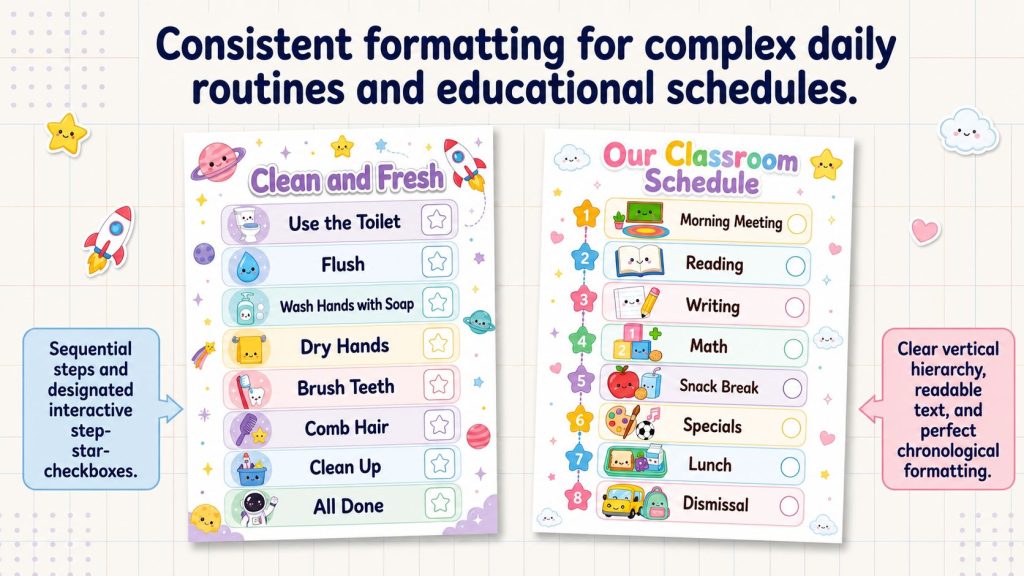
The third is skipping the print test — generating a design on-screen is not the same as confirming it actually prints cleanly at US Letter size with readable text and properly aligned checkboxes, so a physical test print before listing anything is worth the extra few minutes. None of these are specific flaws in TinyChart Prompt Vault itself; they’re general pitfalls with any AI-prompt-driven printable workflow, and knowing them upfront makes the $17 more likely to pay off.
Frequently Asked Questions – TinyChart Prompt Vault Review
Get These 6 Bonuses When You Buy Through My Link
I’ve added these extra bonuses to help you get more value from your purchase and move faster with promotion, automation, traffic, and sales.
DFY Social
A done-for-you social media bonus created to help you promote offers faster without starting from a blank page.

Quantum AI
A powerful AI-focused bonus designed to help you improve productivity, create faster, and simplify your online workflow.
Anonymous AI
Learn how to build and promote online using AI without needing to show your face or become a personal brand.

Video Marketing Profits
A practical bonus focused on using simple videos to attract attention, build trust, and drive more clicks to your offers.
High Ticket AI
This bonus helps you understand how AI can be used around premium offers, positioning, and higher commission opportunities.
Traffic Funnel Blueprint
A simple funnel blueprint to help you understand how to move visitors from traffic sources toward your affiliate offer.